Lower-effort use
Four integrated dispensers reduce the need to lift, open, and replace individual bottles, making common shower products easier to access with limited hand dexterity.
ME 170 / Computer-Aided Design
A foldable, wall-mounted shower caddy with refillable dispensers, designed to simplify shared-bathroom routines for students and people with low hand dexterity.

The Design Brief
Student interviews repeatedly identified conventional shower caddies as bulky, difficult to store, prone to collecting moisture, and awkward to use when no shelf is available. The team responded with a single product that combines dispensing, wall mounting, drainage, and compact storage.
Four integrated dispensers reduce the need to lift, open, and replace individual bottles, making common shower products easier to access with limited hand dexterity.
A central hinge lets the caddy fold in half outside the shower, reducing the space it occupies in a dorm room or shared bathroom.
Four rear suction cups hold the caddy on the shower wall, keeping products off the floor and positioning the dispensers within comfortable reach.
Product Development
The project covered the complete early-stage design workflow rather than CAD alone. Requirements, concept selection, part design, tolerancing, manufacturing, and cost were treated as connected decisions.
Interviewed UIUC students about inconvenient everyday products and recurring problems in dorm life.
Translated the research into priorities around durability, affordability, versatility, compactness, and ease of use.
Compared several concepts with a Pugh matrix and retained the strongest dispensing, storage, and wall-mounting features.
Built the complete assembly and individual components in CAD, including the folding structure and pumping mechanism.
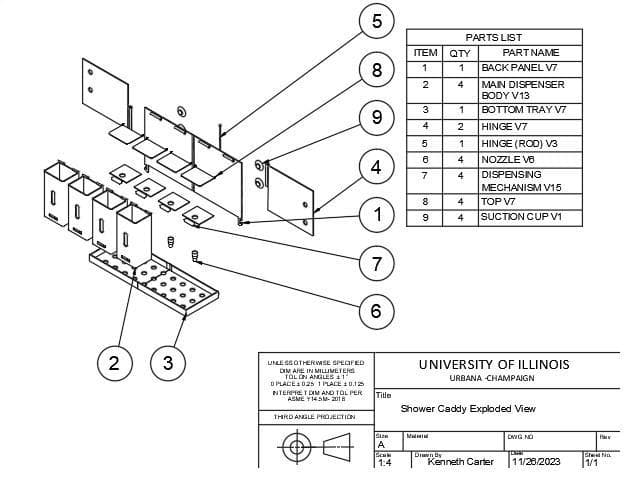
Created an exploded assembly, bill of materials, detailed part drawings, tolerance analysis, and a manufacturing proposal.
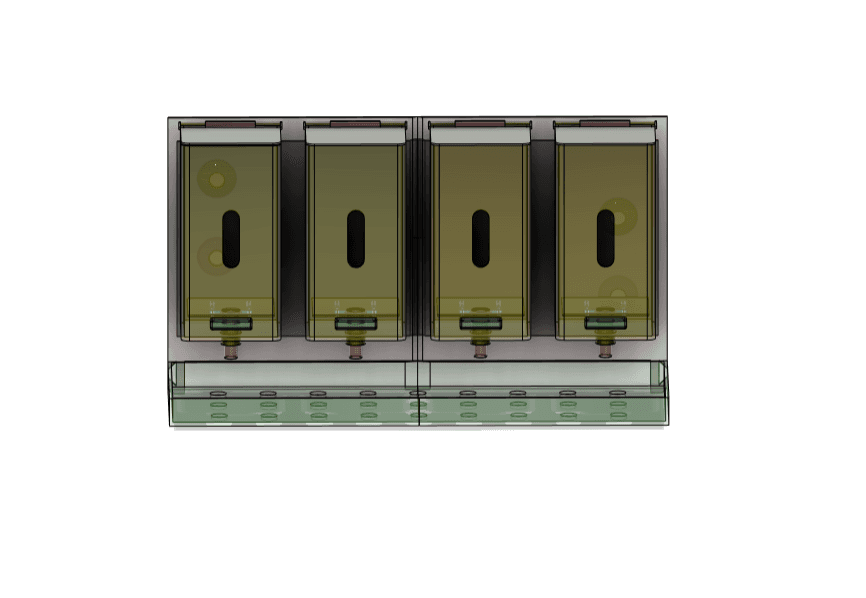
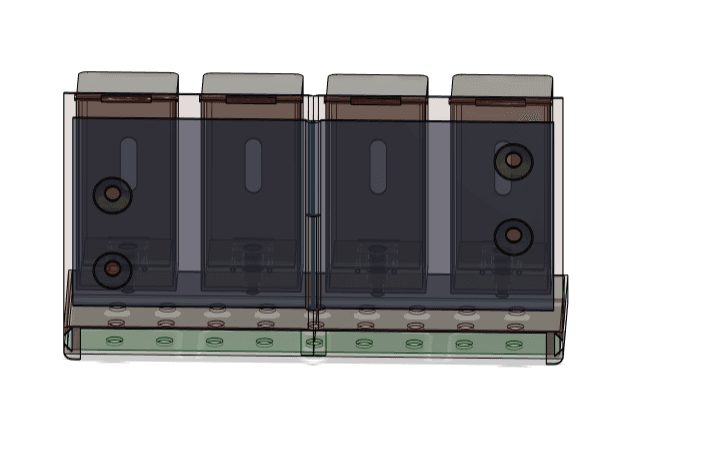
Assembly Definition
The final package included part and assembly models, an exploded assembly drawing, a bill of materials, cross-sections, and detailed drawings for the back panel, tray, hinges, dispenser body, nozzle, button, lid, and top.
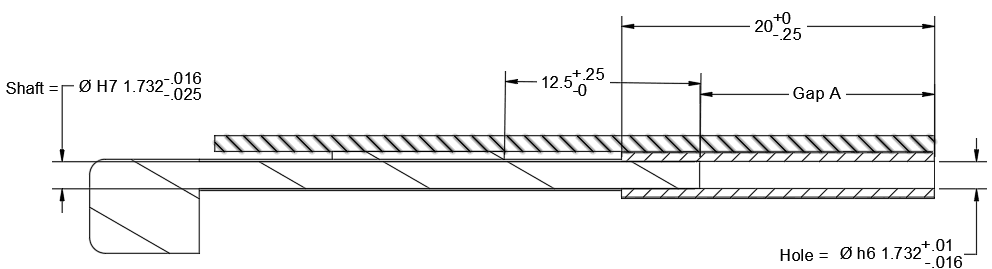
Pumping Mechanism
The sliding shaft required a close fit with the dispenser body so product could not seep around the seal. A tight H7/h6 fit was selected, and radial and axial clearances were checked to keep the mechanism aligned while preserving its motion.
ABS and injection molding were proposed for the main parts to balance moisture resistance, durability, weight, and production cost. Flexible suction cups would be produced separately and attached during assembly.
SuperCaddy connected user-centered product definition with parametric CAD, assembly planning, engineering drawings, fits and tolerances, material selection, and the economics of bringing a product to market.